|

< back to sushi recipes - main page
SUSHI LESSONS - ALL ABOUT FISH
How and where to purchase sushi grade seafood; also how
to prepare
 Sushi restaurants use both fresh and frozen fish.
With today’s freezing technology, fish can be frozen quickly to retain
freshness, flavor and color. As long as it is not kept frozen a long time and goes
to the market quickly the fish will have a good fresh flavor. Sushi restaurants use both fresh and frozen fish.
With today’s freezing technology, fish can be frozen quickly to retain
freshness, flavor and color. As long as it is not kept frozen a long time and goes
to the market quickly the fish will have a good fresh flavor.
However, I recommend you stay away from packaged frozen
fish, unless it is sold specifically as sushi grade.
There are a lot of sushi grade fish suppliers on the Internet that provide fresh
fish and frozen fish. Supermarkets sometimes have sushi grade fish. Most of the time
it will have been frozen and defrosted before sale. This fish is okay when it has
just been defrosted, but don’t keep it for sushi more than 2 days.
Keep sushi fish on ice in your meat box part of the refrigerator. Tell the fish
sales person that you need fish for sushi, ask which days fish is delivered and get
them to pick you out some nice sushi grade fish. Never use fish with a fishy odor.
How To Spot A Fresh Fish
 Look for fillets that are bright in color, not
dull or darkened or dry looking. Buy loins or thick fillets, not steaks because they
are much better for slicing. Try to find fillets at least one inch thick, so you can
slice a wide enough piece for Nigiri sushi. You can see some methods of slicing for
various thicknesses of fish in the fish preparation area of this page. Look for fillets that are bright in color, not
dull or darkened or dry looking. Buy loins or thick fillets, not steaks because they
are much better for slicing. Try to find fillets at least one inch thick, so you can
slice a wide enough piece for Nigiri sushi. You can see some methods of slicing for
various thicknesses of fish in the fish preparation area of this page.
If you live near the coast you can locate fresh fish at the port or at small quality
seafood stores. If fish is whole, it should be firm to touch not squishy, eyes
bright not cloudy or discolored and scales must look fresh and bright not dull.
Scales should be intact, no loose scales.
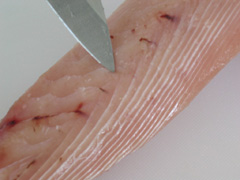
Try to avoid purchasing Ahi tuna or albacore loins that have too many distinct white
lines in the flesh. This is a soft sinew and has a slight stringy texture, not
suitable for Nigiri sushi. This part of the fish is fine to cook, or it can be used
for roll sushi. When chopped, the sinew will easily pull away from the flesh.
Photos show albacore with white sinew lines and next a piece from the same loin
with no sinew. I am cutting this to shape for Nigiri slices. (See fish
preparation section below).
 Crabmeat Crabmeat
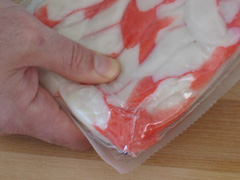
Use cooked real Crabmeat or imitation, it’s
your choice. It’s amazing how imitation crab tastes so good in sushi, and
that’s what I use. To select imitation crab, squeeze the packet with your
fingers. If it is nice and soft, then the texture is good and product moist. If it
is firm or hard when squeezed the product is dry and may be course in texture.
Always pick the soft product.
Shrimp
Shrimp should be as fresh as possible, or fresh frozen. The shrimp should be 3 to 3?
inches long when they are stretched out straight, or ask the fish salesperson for
size 21-25 count. Do not use previously “de-veined shrimp.” They will
not work for Nigiri sushi because their backs are cut to remove the vein which
causes the shrimp to split in two when butterfly cut for sushi. I have special
directions for cooking and preparing butterfly shrimp for sushi rolls and Nigiri
sushi in the Recipes for Nigiri sushi toppings section.
Fish Preparation - Slicing fish for Nigiri sushi
Purchased fish comes in different shapes and
sizes. The following slicing guide demonstrates cutting three different shape pieces
of loin: salmon, ahi and albacore. Use a long 8 to 10 inch slicing knife. It must be
very sharp, especially for tender seafood such as ahi tuna and albacore. You can
find a very reasonably priced sushi knife to fit your needs in our store
section.
When using fish loins or fillets, look closely and remove any bones with fish
tweezers or kitchen pliers. Normally with salmon fillets it’s possible to cut
fish into a block shape about 1 to 1 1/2 inches thick, 3 1/2 wide and 4 to 5 inches
long, as in the salmon photo. This size block is easy to slice.
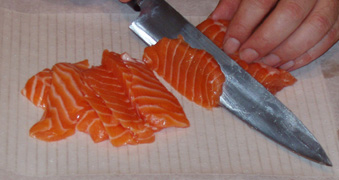 The general rule is to slice across the grain of the fish; this ensures the
resulting slice is tender and has an attractive crosscut grain pattern. Lay your
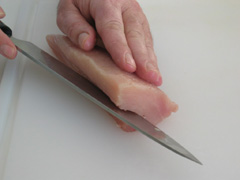
knife on the fish at the very back end part of the blade. Cut straight across the
width of the block, with the blade at an angle of about 45 degrees, as in the salmon
picture.
The general rule is to slice across the grain of the fish; this ensures the
resulting slice is tender and has an attractive crosscut grain pattern. Lay your
knife on the fish at the very back end part of the blade. Cut straight across the
width of the block, with the blade at an angle of about 45 degrees, as in the salmon
picture.
Draw the blade across the fish in one long stroke to complete the slice. If you do
not complete the slice in one stroke, lift the knife out of the cut and carefully
repeat the slicing motion in the same direction. Avoid using a sawing motion as this
could damage the fish.
Slice fish a little more than 1/8 inch and less than 1/4 inch thick. Slices for
sushi magic can be a variety of sizes, although are best cut at 3 1/2 inch long, and
about 1 1/4 inch wide as in the salmon photo.
Keep the hand holding the fish behind the knife blade for safety as in these
photos.
Fish loins and fillets come in different shapes and sizes. Here are some examples of
slicing at different angles to obtain a slice of the desired dimensions,
approximately 3 1/2 x 1 1/4 inches. Remember that Sushi Magic will accept
slices varying in length from 2 to 4 inches, it is your choice.
Ahi Tuna
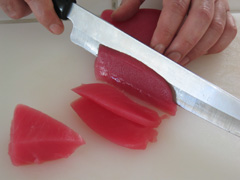 This piece of Ahi is narrower than the salmon
piece, so I cut it in half and then cut the narrower half lengthwise to form two bar
shapes. These bars can be used later for sashimi or for spicy tuna roll. This piece of Ahi is narrower than the salmon
piece, so I cut it in half and then cut the narrower half lengthwise to form two bar
shapes. These bars can be used later for sashimi or for spicy tuna roll.
The remaining larger block of ahi is cut for Nigiri sushi slices. The ahi
pictured is about 3 inches wide and 1 inch thick.
In this case, lay the blade across the block at an angle about 45 degrees, then
slice through the fish at flatter 35-40-degree angle.
These numbers do not have to be exact. Look at the photo and you will get the idea.
The narrower and thinner the fish block, you will need to use a progressively lower
blade angle.
You will soon get accustomed to slicing different cuts of fish.
Albacore
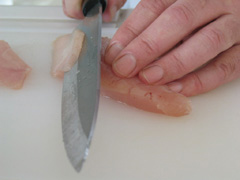 In this case the albacore block has a pointed
side, which is cut away to flatten the block. Also it happens to be narrower than
the ahi and salmon block, and therefore the knife angle used across the fish is
different again. In this case the albacore block has a pointed
side, which is cut away to flatten the block. Also it happens to be narrower than
the ahi and salmon block, and therefore the knife angle used across the fish is
different again.
To make slicing easier, place the fish at an angle away from you on the cutting
board.
Any remaining scrap pieces can be chopped for different sushi roll fillings. You can
see more slicing technique in the intermediate sushi class.
Albacore can also be seared on a grill before slicing and serving. If no grill is
available use a non-stick sauté pan.
Albacore is oily so sear without any additional fat or oil. More on seared seafood
in the intermediate sushi lessons.
 for some exclusive recipes, see our
Sushi Recipes
Page for some exclusive recipes, see our
Sushi Recipes
Page
|
 |
|
|
|
 NEW — How To Make Sushi
— SUSHI'S SECRETS — NEW PRICE $19.99! NEW — How To Make Sushi
— SUSHI'S SECRETS — NEW PRICE $19.99!
This DVD is better than most sushi books! A
unique experience!
The SUSHI'S SECRETS DVD is a fun, easy and entertaining way for you to
learn how to make delicious sushi at home. Never before has an authentic Japanese
Sushi chef and instructor revealed his 20 years of know-how like this. Following the
step-by-step instructions you will be amazed by your own results. You'll enjoy
rolling your own sushi and you'll also be able to delight your family and friends.
65 minutes of video! PLUS A FREE NUTRITION CHART!
Learn more on our Sushi DVD Page How To Make Sushi - Sushi Making DVD
— SUSHI'S SECRETS
NEW - Sushi Magic Sushi Maker -
The Ultimate Sushi Making Kit
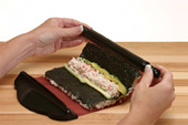 Sushi Magic is the world's
best home sushi maker! Acclaimed by home users and chefs alike, Sushi Magic is a
complete sushi making system that really works. Each kit includes two sushi makers
in one attractive gift box, free sushi lessons with techniques and secrets for
making great sushi, and where to find and how to prepare sushi grade fish, seafood,
and ingredients. Sushi Magic is the world's
best home sushi maker! Acclaimed by home users and chefs alike, Sushi Magic is a
complete sushi making system that really works. Each kit includes two sushi makers
in one attractive gift box, free sushi lessons with techniques and secrets for
making great sushi, and where to find and how to prepare sushi grade fish, seafood,
and ingredients.
See our online demos!
New – Wall Size
Sushi Poster
This beautiful Sushi Poster makes a wonderful gift!
Wall-sized, it is also available in a special laminated version.
ORDER NOW AND GET FREE SHIPPING!
The Sushi Poster features a beautiful spread of sushi fish and classic sushi
rolls with Japanese names and English translations. The background is a photo
texture of soft wood. You will love this beautiful Sushi Poster! Sushi Poster - Wall
Size - 33" x 21"
|
|